Essay
Why Memorize When You Can Systematize?
Building Trading Mastery Through Externalization
The Problem With Traditional Mastery
Most traders spend years trying to internalize best practices:
- Read Kelly Criterion, struggle with the math, apply it inconsistently
- Learn about revenge trading, still fall victim to it after losses
- Study position sizing, mess it up under pressure
- Understand risk management, override it when markets move
The traditional path: Absorb knowledge → internalize it → apply it manually → fail repeatedly → eventually master it (maybe)
Time required: 5-10 years
Success rate: ~10%
Limiting factor: Human memory, discipline, and emotional control
I looked at this path and thought: Why?
Why spend a decade trying to memorize and internalize best practices when I could systematize them once and access them perfectly, every time?
Phase 1: Aggregate (Don't Memorize)
When I started learning trading, I didn't try to become a walking encyclopedia of trading knowledge.
Instead, I treated it like a knowledge aggregation project:
What I did:
- Read the books everyone reads (Kelly, risk management, trading psychology)
- Identified the core best practices (position sizing, emotional discipline, stop losses)
- Dumped everything into a Claude Project
- Organized it into modules (not in my brain, in a system)
Key insight: I wasn't building "Eddie's trading style." I was building "a synthesis of collective trading wisdom, parameterized and accessible."
The files looked like:
/risk-management
  - kelly-criterion.md (optimal position sizing)
  - stop-loss-rules.md (when to exit)
  - daily-loss-limits.md (circuit breakers)

/psychology
  - revenge-trading-prevention.md
  - overtrading-detection.md
  - loss-streak-handling.md

/strategies
  - mean-reversion.md
  - momentum.md
  - arbitrage.md
This wasn't a personal journal. This was an externalized knowledge base of best practices.
Phase 2: Systematize (Make It Software)
Having a knowledge base is great. But knowledge sitting in markdown files doesn't execute trades.
When Claude Code arrived, I took the next step:
"Turn this knowledge base into a working application."
I pointed Claude Code at my DeepStack project and said:
- "Here's the Kelly Criterion logic — make it calculate optimal position sizes"
- "Here's the emotional firewall rules — prevent revenge trading automatically"
- "Here's the risk management parameters — enforce them in code"
What emerged: DeepStack, a web application that could analyze trades, size positions, and enforce discipline — all based on the systematized best practices.
Not my rules. The field's rules. Just encoded.
Phase 3: Parametrize (Make It Configurable)
Here's where it gets interesting.
Because I'd externalized general best practices (not personal preferences), I could now parametrize them.
I created profiles:
Conservative Profile:
- Kelly fraction: 0.25 (quarter-Kelly, very safe)
- Max position: $25
- Stop loss: Tight (3-5%)
- Revenge trading prevention: Aggressive (30min cooldown)
Aggressive Profile:
- Kelly fraction: 0.75 (three-quarter Kelly, high risk)
- Max position: $100
- Stop loss: Wider (8-10%)
- Revenge trading prevention: Moderate (15min cooldown)
Scalper Profile:
- Kelly fraction: 0.5 (balanced)
- Max position: $75
- Stop loss: Very tight (2-3%)
- Trade frequency: High
Same knowledge base. Different risk appetites.
Traditional traders have to choose one style and internalize it. My system can switch between them instantly because the underlying wisdom is parameterized, not hardcoded.
Phase 4: Automate (Let It Run)
Tonight, with Clawdbot's help and Claude Code, I took the final step:
"Take this systematized knowledge and make it autonomous."
What we built in ~3 hours:
A trading bot that:
- Scans 2,510 Polymarket markets + 100+ Kalshi markets simultaneously
- Runs 3 strategies at once (mean-reversion, combinatorial arbitrage, cross-platform arbitrage)
- Uses Kelly Criterion for every position (perfectly, every time)
- Enforces emotional firewall rules (can't revenge trade even if it wanted to)
- Operates 24/7 with $0/hour in API costs
- Based on a research paper showing $40M in extracted profits
But here's the thing: I didn't build this in 3 hours.
I built the foundation over 6-8 months:
- Aggregated best practices into Claude Projects
- Systematized them into DeepStack
- Parametrized them into profiles
Tonight's 3-hour sprint was just assembly of proven components.
Why This Changes Everything
Traditional mastery model:
- Learn → Internalize → Execute manually
- Limited by human memory and discipline
- Takes years to master
- Can't scale (you're the bottleneck)
Systematization model:
- Learn → Externalize → Parametrize → Automate
- Limited only by system architecture
- Access mastery immediately
- Scales infinitely (software executes)
Example comparison:
Traditional trader:
- Reads about Kelly Criterion
- Tries to calculate it mentally during trades
- Gets emotional, forgets the math
- Oversizes position, blows up account
My bot:
- Kelly Criterion encoded once
- Calculates optimal size for every trade
- Zero emotion, perfect execution
- Never oversizes, enforces limits
The traditional trader is trying to memorize and execute.
The bot is systematized expertise, executing optimally.
The Compounding Effect
Here's where it gets exponential.
Each project I build becomes infrastructure for the next:
DeepStack (6 months building):
- Risk management layer
- Kelly sizing
- Emotional firewall
- Trade journaling
MILO (Thanksgiving, 2 weeks):
- Used DeepStack patterns
- Task/signal architecture
- Built 10x faster
Trading bot (tonight, 3 hours):
- Used DeepStack components
- Used MILO patterns
- Used Claude Code
- Built 100x faster
Next project (tomorrow, minutes?):
- Will use all of the above
- Will be 1000x faster
This is why AI-assisted building compounds exponentially:
Each project creates reusable infrastructure. The next project uses that infrastructure + adds new capabilities. Time-to-build keeps shrinking.
Traditional development: Linear (start from scratch each time)
AI-assisted systematization: Exponential (build on everything previous)
The Meta-Lesson (Beyond Trading)
This isn't just about trading.
The principle applies to any domain:
Instead of trying to memorize expertise:
- Aggregate - Collect best practices
- Systematize - Organize into modules
- Parametrize - Make it configurable
- Automate - Let software execute
Examples:
Writing:
- Aggregate style guides, grammar rules, storytelling techniques
- Systematize into templates and patterns
- Parametrize for different audiences (technical, casual, academic)
- Automate with AI writing assistants
Product Management:
- Aggregate frameworks (Jobs-to-be-Done, Lean Startup, etc.)
- Systematize into decision trees and workflows
- Parametrize for different product types
- Automate with AI PMs
Any expertise-based field:
- Stop trying to memorize everything
- Start systematizing collective wisdom
- Make it accessible and executable
- Let AI handle the execution
The Three-Hour Illusion
When people hear "I built a trading bot in 3 hours," they miss the real story.
The truth:
- 6-8 months aggregating trading wisdom into Claude Projects
- Several months systematizing it into DeepStack
- Weeks parametrizing into profiles
- Then 3 hours assembling it into an autonomous bot
The 3 hours were fast because the foundation was already built.
It's like saying "I built a house in 3 hours" when what you really did was:
- Spend 6 months designing blueprints
- Fabricate all components in a factory
- Then assemble them on-site in 3 hours
The speed comes from systematization, not raw coding velocity.
What's Next
Right now, as I write this, my bot is running:
- Scanning 2,500+ markets every 60 seconds
- Comparing prices across platforms
- Looking for arbitrage opportunities
- Costing $0/hour to operate
It's not trading yet (waiting for account funding), but it's ready.
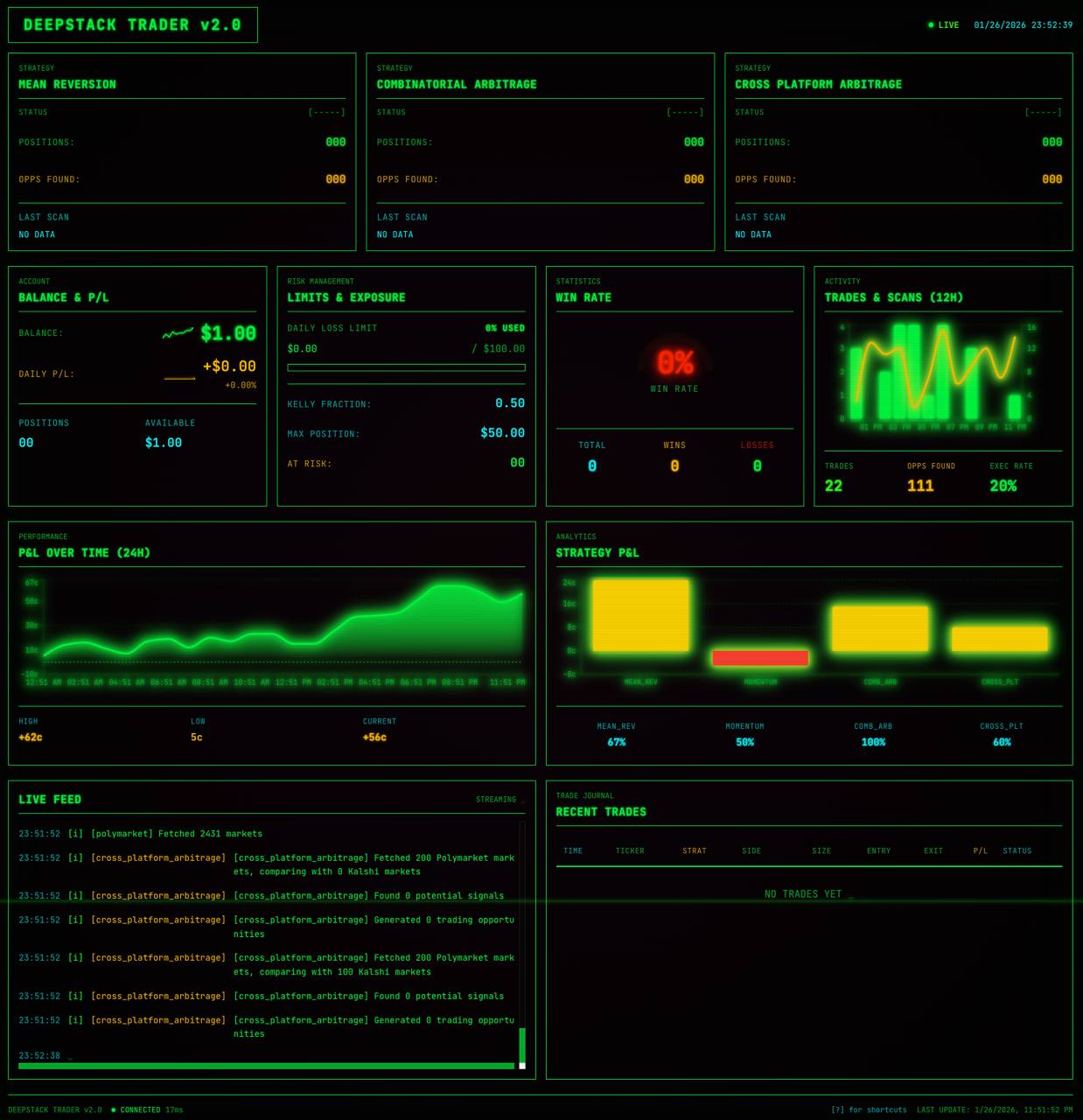 The real-time dashboard: green phosphorus terminal aesthetic, live market feed, ASCII charts showing P&L. All built tonight.
When markets open tomorrow morning:
- Mean-reversion will find opportunities in S&P 500 markets
- Cross-platform arbitrage will catch pricing discrepancies between Polymarket and Kalshi
- Combinatorial arbitrage will hunt for guaranteed profits in related markets
All using the same systematized best practices I aggregated months ago.
The bot executes better than I ever could manually because:
- It never forgets the rules
- It never gets emotional
- It calculates Kelly sizing perfectly every time
- It can scan thousands of markets simultaneously
- It never needs sleep
That's the power of systematization.
The Real Question
The question isn't "How did you build this so fast?"
The question is: "What expertise are you still trying to memorize instead of systematize?"
Because here's the truth:
In 2026, memorizing expertise is optional.
You can externalize it, systematize it, parametrize it, and automate it.
The traders who win aren't the ones with the best memory.
They're the ones who build the best systems.
And those systems compound.
Every project becomes infrastructure.
Every insight becomes reusable.
Every hour of building multiplies future speed.
I'm not just building a trading bot.
I'm building compounding cognitive leverage.
And it's accelerating.
Appendix: The Stack
For the technically curious, here's what the trading bot actually looks like:
Infrastructure:
- Kalshi API - Execution (production keys, RSA-PSS auth)
- Polymarket API - Data source (read-only, 2,500+ markets)
- DeepStack - Risk management (Kelly sizing, emotional firewall)
- StrategyManager - Orchestration (3 strategies running simultaneously)
Strategies:
- Mean-reversion - Buy when prices deviate from 50¢ (45-55¢ range)
- Combinatorial arbitrage - Exploit pricing inconsistencies in related markets (research-backed: $40M extracted historically)
- Cross-platform arbitrage - Use Polymarket data to predict Kalshi movements
Profiles:
- Conservative ($25 max position, 0.25 Kelly)
- Aggressive ($100 max position, 0.75 Kelly)
- Scalper ($75 max position, 0.5 Kelly, fast exits)
Cost: $0/hour in API fees (both APIs are free for read-only access)
Development time:
- Foundation (DeepStack): 6-8 months
- Assembly (trading bot): 3 hours
- Total effective time: ~3 hours (because infrastructure existed)
Tools used:
- Claude Projects (knowledge aggregation)
- Claude Code (codification)
- Clawdbot (coordination & oversight)
The code: Thousands of lines of Python, all generated by Claude Code in minutes, orchestrated by AI agents.
This is the new paradigm.
P.S. If you're still trying to memorize expertise instead of systematizing it, you're competing with people who aren't. Choose accordingly.